I do not have much experience when it comes to filming but I have used previous software that is used in photography. Both would be used in this topic and both for different things.
I have previously learnt about camera angles in media studies last year, and learnt about cinematography, editing, sound, techniques. I also went into depth in these areas learning about things such as Mise-en-Scene (everything in the frame/scene) and also jump-shots (where the camera jumps from shot to shot).
The software which may link to this assignment will be software such as Adobe Premiere and Adobe Photoshop. I have never used Premiere before but am advanced in Photoshop as I have been using it for two years now. I would like to find out about Premiere as it would be beneficial to know how to edit videos differently to Encore. Also knowing how to use Premiere would mean I have covered a vast area of editing software, from photos to videos and also how to create DVD menus. Which is all important when I want to work in the media industry.
Saturday, 8 January 2011

Friday, 7 January 2011
Friday, 10 December 2010
My DVD Menu
Below is the weekly diary of the processes I went through to create my DVD menu. It includes some problems I encountered and also my personal opinion on how I was feeling about the project.
Week 1
This week we were given the assignment brief which included what we had to create. Looked at existing DVDs: Stranger than Fiction, The Wrestler, The Plank and Michael Moore ‘The Big One’. We noted codes and conventions and gained an idea of what I needed to include. We were told that I had to choose between Independent Horror, Independent Sci-Fi, Independent Drama/Thriller or Children’s Animation. It was not until Friday that I decided to take idea of Children’s Animation further. I produced a moodboard on it and scanned it onto Photoshop and edited it with colour. I created a contingency plan explaining problems that may arise and also resolutions to these problems – this would save me time if I have a problem and also could stop me using up valuable time.
Week 2
This week we had a recap of Photoshop as a class. We were told to find an image on the internet with a neutral background (white) and then we edited it to find techniques we could use in our work. I found a pictures of some banana’s and decided to blur some of the image while overlapping in other parts. I could use this in my DVD menu to create a motion effect or dramatic effect. We were also told about codecs, what they were and how we use them in Encore. This is to help us because next week we’re going to produce a DVD menu! I’m looking forward to it, as this will be the first time I’ve ever used Encore.
Week 3
This week we created a DVD menu with links. We were given a booklet to look through that Simon had created, and were told to go through each step and the outcome would be a DVD menu. The booklet instructed us to use pictures and video-clips already on the hard drive at college. I struggled at first because there was a lot of buttons on Encore that I had never used in other Adobe products and software. We created a DVD with working Menu, Scene Selections etc. all on Encore. Along side this, we researched graphics such as Raster graphics and Vector graphics with Andy, so we had a theory side as well as a practical side. I thought of initial ideas for Children’s Animation: Toys, Animals and People, mainly because I could find existing children’s animation films with these in and therefore I could use ideas from them and this could be used as looking at existing DVDs as well! I sketched up about 4 different vague designs of how I wanted the home page to look.
Week 4
I researched into the final product looking at 6 main areas:
- Client and audience needs
- Target audience
- Resources and Budget
- Techniques
- Similar/Existing products
- Legal and ethical considerations
This information would be used for my pitch I am going to create next week. I managed to find all information but came across a problem with the Budget as it was the most difficult to find on the internet. I need to look at this over the weekend so that I don’t leave it out of my pitch.
Week 5
This week I pitched my idea of my DVD menu to the class and to the camera. It went well but stumbled in some places – it gave me more confidence in class and also helped me think how the media industry works. I thought I could of included more content but I did not have enough time because I was working all weekend. I managed to find budget for a graphic designer off the internet and I put this information in the pitch. I created the presentation on Prezi (www.prezi.com) which was different to other people who just used Microsoft Powerpoint because it used animation and was a more interactive presentation which I hope captured their attention a lot more than pages of information and boring transitions. I looked at all what my DVD menu would include but forgot to include how it would look (visually). The lecturers said that we will be given feedback in a few weeks.
Week 6
This week I sketched ideas of my story-boards (process of the transitions of the DVD pages) and created brief sketches of characters. The characters are very basic but I am more confident with the ideas of the menu now. The film is going to be called ‘SAM’ after the main character (teddy bear) and also chose names for the main boy character (Alfie). Most of the menu now is still just ideas and I need to develop them next week and gain more finalised ideas.
Week 7
This week, I finalised the pictures of my characters and other little details which I then sketched, scanned and edited on Photoshop. I also finalised my storyboards and added annotation to them. I generated my backgrounds for my menu on Photoshop and created a new project for my menu on Encore. I used codecs which are things that tell Encore if it’s a button, a picture or a rollover effect. A button would use the code (+) and would be a group format on Photoshop; a rollover effect would use the code (=1) and would be under a group in Photoshop; and a picture without animation would have no code on Photoshop.
Week 8
This week I began to finalise backgrounds of my menu on Photoshop and started to link the DVD menu pages together on Encore. We were given feedback from the pitch and I did rather well but could of improved in places such as more visual content but was told I was confident at the way I presented it – which I’m happy about! I need to stick to more deadlines though as the work is due-in in 2 weeks!
Week 9
This week was rather dull, the snow restricted me from going into college and using the Encore software at home so therefore I just got on with my paperwork. We’re already 2 weeks behind schedule and now we’re going to be 3 weeks behind so I have to really crack on with Encore next week!
Week 10
I carried on with linking the pages using the pick-whip tool and i got ready to burn my DVD.
I came across a few problems. I forgot to bring in a DVD for start, so I had to borrow one of my friend and I also forgot to add music to it, so this will probably bring my mark down. I wrote my evaluation as well, explaining problems and resolutions of my project. Now it’s time to hand in the project!
Friday, 5 November 2010
A look at online newspaper websites
I was looking at several newspapers the other day, and I noticed that different newspapers portrayed a same story but with a different view on it. Usually one would be negative and others would just state what the story is about. It got me wondering whether the newspaper websites targeted different people and why they did this. I looked at a broad range of Britain's most read newspapers and researched them and the companies who run them, to understand why they reported in different views.
Newspaper owners:
Trinity Mirror plc. - Daily Mirror, Sunday Mirror and People.
Northern & Shell - Daily Express, Sunday Express, Daily Star and Daily Star Sunday.
Daily Mail and General Trust plc. - Daily Mail, The Mail on Sunday and Metro.
News Corporation - The Sun, News of the World, The Sunday Times and The Times.
Guardian Media Group plc. - The Guardian and The Observer.
The Telegraph Media Group - The Daily Telegraph, The Sunday Telegraph, and The Spectator.
Alexander Lebedev and Evgeny Lebedev - Evening Standard, The Independent and The Independent on Sunday.
Pearson plc. - Financial Times.

The People
Established in 1881, The People is a magazine that is printed for every Sunday, and therefore is a weekly newspaper. Instead of reporting on important issues, The People tends to focus on celebrities and regularly reports on scandals with famous people. This is shown very clearly on the homepage of the website, by pictures of celebrities in the public eye (predominantly X-Factor) and short words and phrases as opposed to long sentences. The news is on the 4th tab on the heading bar at the top of the screen, with Celebs+TV and Sport ahead of it, meaning they report more of these stories as a newspaper.

The Daily Telegraph
The Daily Telegraph is one of only a few British broadsheet newspapers and was the highest selling British broadsheet in 2009 beating big newspapers such as The Times, The Guardian and The Independent. It is a paper that promotes Conservative policies and this is evident in the way the newspaper will either back the current government or criticise it, so I wondered if this was evident on the online website. Upon first glance of the homepage I could not see anything to support Conservative beliefs but maybe this was done because at the moment there is no big political problems with the current Conservative Government, and therefore they do not want to pick up on any negative news about the Government.

The Financial Times
www.ft.com/home/uk

As with The Daily Telegraph, The Financial Times is a daily broadsheet newspaper which was founded in 1888. It is the only newspaper in the UK which provides reports on world financial markets in particular, London's Stock Exchange. The Financial Times is also a Conservative newspaper, and this is more than likely because it is aimed at the upper middle class (which Conservative policies target) as opposed to the working class (which Labour policies target). The upper middle class tend to read broadsheet newspapers as opposed to tabloid newspapers which the working class tend to read. The website shows how little it focus's on the news and instead focus's on the economy and money, with stories linked to American politics and on the menu bar at the top of the screen there are pages such as Management, Personal Finance and Life & Arts.

The Sun
The Sun is Britain's most popular newspaper and this is surprising as it was only founded in 1963. It is one of four huge newspapers that is owned by Rupert Murdoch's News Corporation. It is not a politically aligned newspaper but instead changes it's view depending on what Government party is popular. They have therefore been responsible for being victorious at many elections, for example the Conservative victory in 1992, Labour's several victory's with Tony Blair and also the more recent victory for the Conservative party under David Cameron (although it was a coalition Government). The website uses predominantly short slogans and brief descriptions of news stories. The Sun targets the working class and therefore focus's on things such as Football, Showbiz and TV - things that are linked to the working class. The Sun has been criticised in the past for writing about articles that have not been proven to be true and have been completely made up, often it targets certain people and can persuade people because of the amount of readers.

The News of the World
Often referred to as the Sunday sister of The Sun, The News of the World is a tabloid newspaper owned by News Corporation. Although it is the sister paper of The Sun, it was founded in 1843 whereas The Sun was founded in 1964, roughly 80 years before. On average, it sells approximately the amount of newspapers a week that The Sun sells a day. The News of the World is a Conservative paper, and prior to the recent elections, featured many articles backing the Conservative party and opposing the Labour party. The website is very much the same as The Sun's website often featuring the most popular news from the week. More recently, in bid to gain more money, The News of the World are charging money for people to read their stories online. This could gain them money but could also mean they lose people, and therefore people would switch to other newspapers.

The Daily Star
The Daily Star is one of the more recent newspapers, founded in 1978. It is a daily tabloid newspaper that is aimed at the lower class people of society through it's demeaning stories and it's cheap price. Upon first glance of the website, I thought it looked very tacky. The featured storylines include: 'JORDAN: MY SEX ORDEAL' and columns such as: 'BABES' and 'DATING'. I personally feel it is a very cheap effort to gain an audience, but the paper is clearly read by people looking at the figures.

The Daily Mail
The Daily Mail is a daily tabloid newspaper founded in 1896. It is the second biggest selling newspaper in the UK after The Sun. It is the only British newspaper that is read by over 50% female. It is often referred to by some as a fascist paper because many feel the use of language and the storylines featured, target individuals or groups of people. From looking at the website, I can see how certain storylines are shown in different ways and their perspective in comparison to other newspapers.

The Guardian
The Guardian is a daily national newspaper whose website is one of the most visited daily English-language news websites. It is a newspaper that has previously supported the Labour government and more recently the Liberal Democrats government. It is not a tabloid newspaper but instead a Berliner newspaper which is just a bit larger than a tabloid and smaller than a broadsheet. From looking at the online website I can see how sophisticated it looks in comparison to websites such as The Sun's. It is a subtle website, not attempting to capture the audience's attention but instead just to inform people of the news. This is shown through the colours but also through the way the language is written.

The Independent
The Independent was created by journalists who wanted to set up a newspaper because they were fed up of editorial control. It is one of the youngest newspapers in Great Britain being created in 1986. It was originally produced in Broadsheet format but has more recently been produced in a tabloid format to appeal to a wider audience. It is a Liberal Democratic follower as it believes in Liberal views but only subtlety puts across these views in it's newspaper. From looking at the website I could see how similar it was to The Guardian's website. It had the same subtlety in both content and it's views on news stories. I got the impression that the website was aimed at more intellectual people instead of a younger audience.

The Observer
The Observer was the world's first Sunday newspaper being founded in 1791. It was originally a broadsheet newspaper but as with several other broadsheet newspapers it is more recently produced in a Berliner format. It is politically alligned the same as it's 'sister paper' The Guardian and the website can be found through The Guardian's website. The website is very much the same as The Guardian's but there is less imagery and more written content. This may not happen everyday but you can see how both papers show the same storyline but in a different way, it shows the diversity but also the similaritys between the daily newspaper and the Sunday newspaper.
For more information on British newspapers see: http://en.wikipedia.org/wiki/List_of_newspapers_in_England
Friday, 29 October 2010
LimeWire ordered to shut down!
LimeWire, one of the world’s most popular file-sharing websites has closed down and has been ordered to pay hundreds if not thousands of copyright infringement money by an American court.
The site which started up in 2000 allowed users to download music, videos, documents and other media for free. For years many famous artists and bands had argued that such peer-to-peer websites should be illegal as they saw it as copyright infringement, but the American laws were too complicated to just class the website as illegal.
When users opened up the LimeWire website on Tuesday October 26th 2010, they were unable to use the programme’s features but instead were greeting with this message:

‘This is an official notice that LimeWire is under a court-ordered injunction to stop distributing and supporting its file-sharing software. Downloading or sharing copyrighted content without authorization is illegal.’
The case follows the closure of the similar P2P website Napster in 2001 which many believe now recent file-sharing websites ideas originated from. Although since Napster, it is believed that the websites are far more complicated and therefore would require more effort to close down by courts.
The LimeWire court case has been going on for four years now and has been a breakthrough for the music industry especially. The Recording Industry Association of America filed for an investigation into the website and the company and have now won and the outcome meant that LimeWire had to disable ‘searching, downloading, uploading, file trading and/or file distribution functionality’. The company itself claims they will not shut down the website but will have to follow the rules now set by the court.
As well as a major breakthrough in the media industry, the case makes you wonder whether we are being limited as to what we can do on the internet. I mean when do you class something as being copyright? Not all files shared on LimeWire were the songs, many were recordings. Is recorded a song classed as copyright? And if not, is singing a song classed as copyright? I think the case is important to note as this is the only 2nd major P2P website closed since 2001, that’s a whole 9 years! There needs to be a real crackdown on the rules and regulations on the internet generally, instead of certain piracy websites because when one site gets shut down, people will only move onto a different website with the same purpose.
Related external links:
http://www.guardian.co.uk/technology/2010/oct/27/limewire-shut-down
http://en.wikipedia.org/wiki/Limewire
http://voices.washingtonpost.com/blog-post/2010/10/limewire_shuts_down_another_fi.html
The site which started up in 2000 allowed users to download music, videos, documents and other media for free. For years many famous artists and bands had argued that such peer-to-peer websites should be illegal as they saw it as copyright infringement, but the American laws were too complicated to just class the website as illegal.
When users opened up the LimeWire website on Tuesday October 26th 2010, they were unable to use the programme’s features but instead were greeting with this message:

‘This is an official notice that LimeWire is under a court-ordered injunction to stop distributing and supporting its file-sharing software. Downloading or sharing copyrighted content without authorization is illegal.’
The case follows the closure of the similar P2P website Napster in 2001 which many believe now recent file-sharing websites ideas originated from. Although since Napster, it is believed that the websites are far more complicated and therefore would require more effort to close down by courts.
The LimeWire court case has been going on for four years now and has been a breakthrough for the music industry especially. The Recording Industry Association of America filed for an investigation into the website and the company and have now won and the outcome meant that LimeWire had to disable ‘searching, downloading, uploading, file trading and/or file distribution functionality’. The company itself claims they will not shut down the website but will have to follow the rules now set by the court.
As well as a major breakthrough in the media industry, the case makes you wonder whether we are being limited as to what we can do on the internet. I mean when do you class something as being copyright? Not all files shared on LimeWire were the songs, many were recordings. Is recorded a song classed as copyright? And if not, is singing a song classed as copyright? I think the case is important to note as this is the only 2nd major P2P website closed since 2001, that’s a whole 9 years! There needs to be a real crackdown on the rules and regulations on the internet generally, instead of certain piracy websites because when one site gets shut down, people will only move onto a different website with the same purpose.
Related external links:
http://www.guardian.co.uk/technology/2010/oct/27/limewire-shut-down
http://en.wikipedia.org/wiki/Limewire
http://voices.washingtonpost.com/blog-post/2010/10/limewire_shuts_down_another_fi.html
Friday, 8 October 2010
Encore Software
Today I used the Encore software for the first time. It is an interactive video software that allows a user to create DVD menus and DVD's. We used clips already on the L:Drive on the college computer to functions such as Introduction, Behind the Scenes and The Lyrics. This is a record of my work and some of the tasks I had to go through to achieve a brief DVD menu.


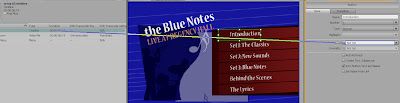
Now you have set up a basic link on a DVD menu!
1. Boot up Encore and select New Project

2. Set appropriate properties

It is important to notice all the different features and functions that the Encore software has to offer, and try to identify any shortcuts, to save time when creating. Also note where the save button is, so you can regularly save and avoid any loss of work.
3. Import as a Timeline
File>Import As>Timeline

This is now my workspace.
After selecting import as timeline a browsing folder appeared. I selected a movie clip on the L:Drive and when I opened it, it appeared on my workspace.

Project Monitor Timeline
Note: Encore works best with the video formats .mov and .avi, choosing the formats .mpeg and .wmv is not advised.
The video symbol with a yellow play icon on the top left shows that the clip will be first played on the timeline.
4. Use 'pickwhip' tool to link buttons to menus and clips
Click appropriate sub-menu on menu and then look on right where a new menu will be displayed, and look out for link. Next to the link should be a swirl button, this is known as the 'pickwhip' tool. Click the button and whilst keeping your mouse button down drag to the appropriate video clip. It should create a line across the page so you know whats being linked (this will disappear once you release your hand off the mouse button).

Now you have set up a basic link on a DVD menu!
Saturday, 2 October 2010
Film Poster Final Outcome


The main changes from the draft to the final were the text. The positive quotes used on the left were taken out as I thought this would clutter the poster and not have the great impact I wanted the poster to have. Instead of the idea of a cellar as a background, I was looking at images on Google and then found a picture of a warehouse that I thought would go well with the figure. I wanted the background to remain dark to enhance the horror genre so I toned down the brightness and added more contrast.
Subscribe to:
Posts (Atom)